
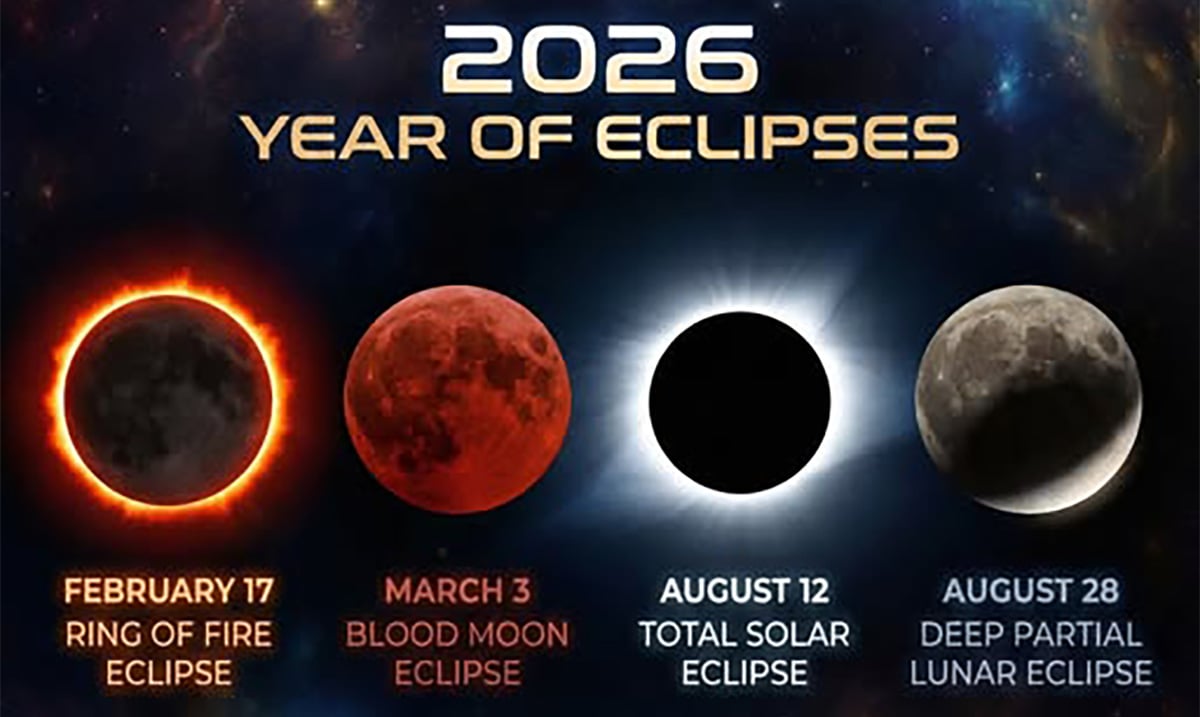
The year opens with a rare and dramatic alignment of the Sun, Moon, and Earth — a reminder that eclipses aren’t random spectacles, but precise cosmic choreography governed by orbital mechanics.
It begins on February 17 with an annular “Ring of Fire” solar eclipse. During an annular eclipse, the Moon passes directly between Earth and the Sun, just as it does in a total solar eclipse. But because the Moon follows an elliptical orbit, it is sometimes slightly farther from Earth and appears smaller in our sky. On this day, it won’t completely cover the Sun. Instead, a brilliant ring of sunlight will blaze around the Moon’s dark silhouette — a fiery halo suspended against daylight.
The narrow path of annularity sweeps across Antarctica, offering one of the most remote eclipse experiences on Earth. Observers in southern South America and parts of southern Africa will witness a partial eclipse, where the Sun appears as though a celestial bite has been taken from it. Even outside the path of annularity, the shifting crescent Sun can cast eerie shadows and produce subtle, strange changes in daylight.
Then, on March 3, the sky turns red.
A total lunar eclipse unfolds when the Moon drifts completely into Earth’s shadow. Unlike solar eclipses, which are visible only along a narrow track, lunar eclipses can be seen from anywhere on the night side of the planet. As the Moon passes through Earth’s umbra — the darkest part of its shadow — it won’t vanish. Instead, it will glow a deep copper or crimson.
This happens because Earth’s atmosphere bends and filters sunlight, scattering shorter blue wavelengths and allowing longer red wavelengths to reach the Moon. In essence, every sunrise and sunset on Earth at that moment is projected onto the lunar surface. For nearly an hour, viewers across the Pacific region — including eastern Australia, New Zealand, and western North America — will watch the transformation into what’s often called a “blood moon,” a phenomenon that has inspired mythologies, prophecies, and scientific curiosity for millennia.
And then comes the main event.
On August 12, a total solar eclipse carves a dramatic path across the Arctic before sweeping over Greenland, Iceland, and northern Spain — marking Europe’s first experience of totality in 27 years. During totality, the Moon will completely block the Sun’s bright disk, revealing the Sun’s outer atmosphere: the ethereal, ghostly corona.
For roughly two minutes along the centerline, daylight will collapse into twilight. Temperatures may drop noticeably. Birds can fall silent. Stars and planets may briefly emerge. The sky takes on a surreal, metallic hue that seasoned eclipse chasers describe as almost otherworldly. It is one of the few astronomical events that can be felt physically as well as seen — a visceral reminder of our planet’s place in a dynamic solar system.
These four eclipses are part of the natural rhythm of eclipse seasons, which occur when the Sun aligns closely with the Moon’s orbital nodes — the points where its tilted orbit intersects Earth’s orbital plane. Without that 5-degree tilt, we would experience eclipses every month. Instead, they remain rare enough to feel extraordinary.
Four eclipses.
Three continents.
Moments of shadow and fire written across the sky.
One unforgettable year. 🌒🔥
If you want over 200+ ideas, phrases, and text messages to drive your man wild with desire for you, make sure to check out my new program, Language of Desire. I give you step-by-step instructions and tons of exact words to use to get exactly what you both want in and out of the bedroom.
P.S. The reason so many men “pull away” from women is because
women don’t understand this naughty secret about men. . .
